
Prairieville Previous-Resident Sources
No one roll spans the life of a Prairieville address. Current parcel data gives the best starting key, while deed indexes, maps, directories, census schedules, newspapers, and vital indexes cover different eras. The strongest result records both what a source proves and what it cannot prove. A deed shows a recorded transfer. It does not show that the buyer moved in, stayed there, or lived alone.
| Source | Verified years | Where held | What it adds |
|---|---|---|---|
| Vendor/vendee land index and images | July 1970 to present | Ascension Clerk online services and office | Parties, instrument, recording data, and available image |
| Mortgage index | 1914 to present; images from July 1970 | Ascension Parish Clerk | Mortgage and lien chronology |
| Map records | 1807 to present | Ascension Parish Clerk | Plats, lots, and subdivision evidence |
| Ascension conveyance index | 1770 to 1957 | FamilySearch | Older name and transfer leads; image access varies |
| Federal census schedules | Released through 1950 | NARA, libraries, genealogy databases | A dated household snapshot under the 72-year rule |
| Local directories | Exact Prairieville run not published | Ascension Parish Library | Possible address-to-occupant and telephone evidence |
For a recent Prairieville home, begin with the parcel and deed. For a trail before the online image range, carry the legal description into the Clerk's map books, the historical conveyance index, and library sources. This era-based method avoids forcing an old record to fit a modern street label.
Fix the Prairieville Parcel First
The Ascension Parish Assessor property-search description confirms searches by address, owner, parcel number, and subdivision. Record the parcel number, owner name, physical address, owner mailing address, subdivision, lot or block, legal description, deed number, prior owner, and sale date when shown. These fields keep a previous-residents search tied to one tract.
Do not merge the mailing and physical fields. The GIS schema stores them separately. A mailing address can belong to an agent, a trust, an estate, a post-office box, or an owner who lives elsewhere. A homestead flag may support an occupancy inference, but it does not list the full household. Preserve the raw values and the date checked before drawing a conclusion.
Key distinction. A situs address locates the parcel; an owner mailing address tells the assessor where to send correspondence.
Walk Prairieville Deeds Backward
The Ascension Parish Clerk Recording Department is the official keeper of deeds, mortgages, maps, and related instruments. Its online services are useful indexes, but the Clerk warns that a web result is not the official public record and indexing may trail assignment of an official number. Use the result to locate the act, then request the office copy when the exact text matters.
- Search the current Prairieville street address in Assessor or GIS records. Copy its parcel number and complete legal description.
- Search the current owner as grantee in eClerksLA or the Clerk's land-record service. Open the purchase deed when an image is available.
- Copy the seller's name, instrument number, book and page, recording date, and legal description. Search that seller as the earlier grantee.
- Repeat the seller-to-grantee search. Keep spouses, successions, trusts, estates, and companies exactly as indexed.
- At the online cutoff, use the Gonzales public terminal, order a book-and-page copy, or ask staff about older deed and mortgage books.
- Grantor and grantee
- The grantor transfers an interest; the grantee receives it.
- Chain of title
- The linked sequence of recorded transfers for the same tract.
- Legal description
- The lot, block, subdivision, section, or boundary text that identifies land when a street address changes.
- Index and image
- An index points to a filing. An image reproduces the recorded document, and availability dates may differ.
Prairieville's Index-Image Divide
Ascension's older access schedule reveals a useful asymmetry. Map records reach to 1807 and mortgage indexing to 1914, while vendor/vendee land images begin in July 1970. An older map or index entry may exist even when no deed image appears online. The FamilySearch Ascension conveyance collection adds 179,887 indexed records from 1770 through 1957, but it remains a lead rather than a certified Clerk copy.
The recorded trail reaches before Ascension Parish's creation in 1807. Clerk history points to Louis Judice notarial acts from 1770 through 1787. Modern parcel numbers will not map straight into those books. Names, map books, legal descriptions, and French or Spanish spelling variants become more useful as the chain moves back.
The legacy Ascension online-access screen shows the older route into these record systems.
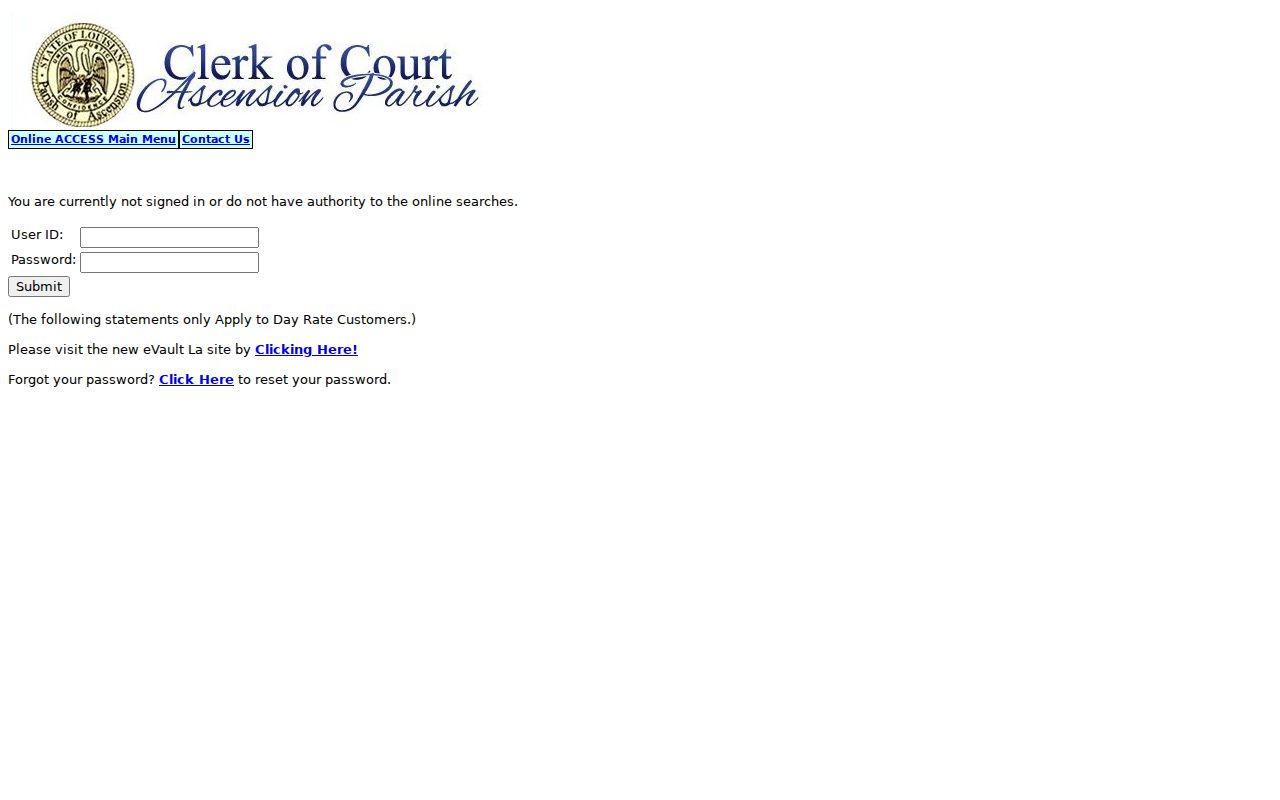
The capture is a reminder to verify current access with the Clerk, since services have been shifting toward eClerksLA and account-based tools.
Note: The Donaldsonville office is closed for roof damage as of the research date, so call before travel and use Gonzales when directed.
Prairieville Households Beyond Owners
Previous owners are not always previous residents. The Ascension Parish Library genealogy collection offers directories, newspapers, microfilm, cemetery inscriptions, and research guidance. The Gonzales branch is the main genealogy hub, while Galvez is the Prairieville branch. Ask the reference desk for an edition-level list of reverse or criss-cross directories because the public catalog does not state a verified Prairieville run.
Pair a dated directory entry with the nearest released census, then search local newspapers and obituaries for the same name and address. A criss-cross directory is arranged by address or phone rather than only by surname. A census enumeration district is the small area assigned to a census taker. Rural routes and changing geography mean the deed's lot and legal description may be needed to bridge the two.
- Choose one deed date and search the closest available directory year for the street address.
- Record every listed householder without assuming the list includes all occupants.
- Locate the nearest public census schedule and compare names, ages, kinship, and neighboring households.
- Use newspapers, marriage leads, obituaries, cemetery books, and succession files to explain later moves or deaths.
The directory collections themselves belong in the Prairieville Directory Book; the backward-address task uses them only as dated household evidence.
Confirm Prairieville Life Events
Birth and death indexes can separate two people with the same name or close a previous-residents trail after a move. Louisiana's historical birth index generally opens births older than 100 years, while the death index covers 1911 through 1975 and applies the state's historical access rule. Current certified records follow separate eligibility and identification rules.
The State Archives historical birth search provides a name-and-date route for older Louisiana records.
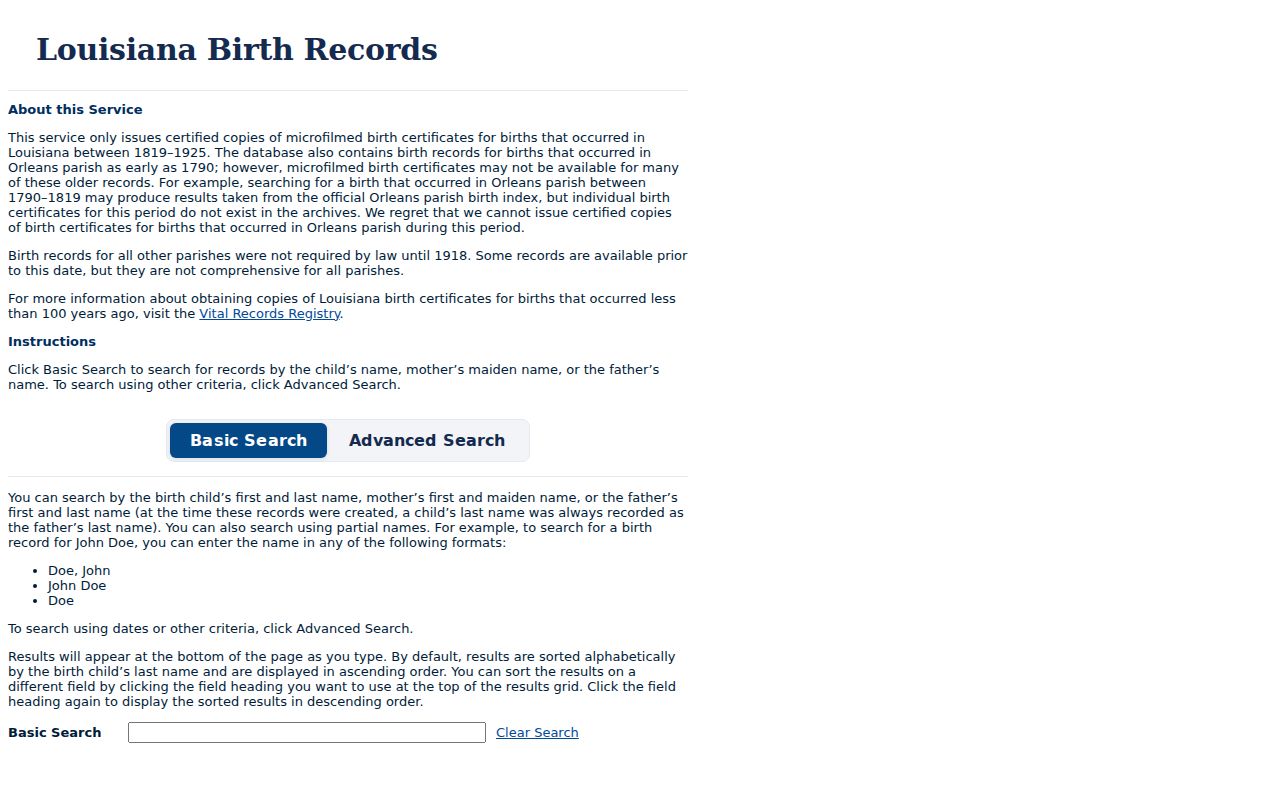
Use a birth hit to test identity, not to claim that a person occupied the address.
The Louisiana historical death index can supply the endpoint needed for an obituary or succession search.
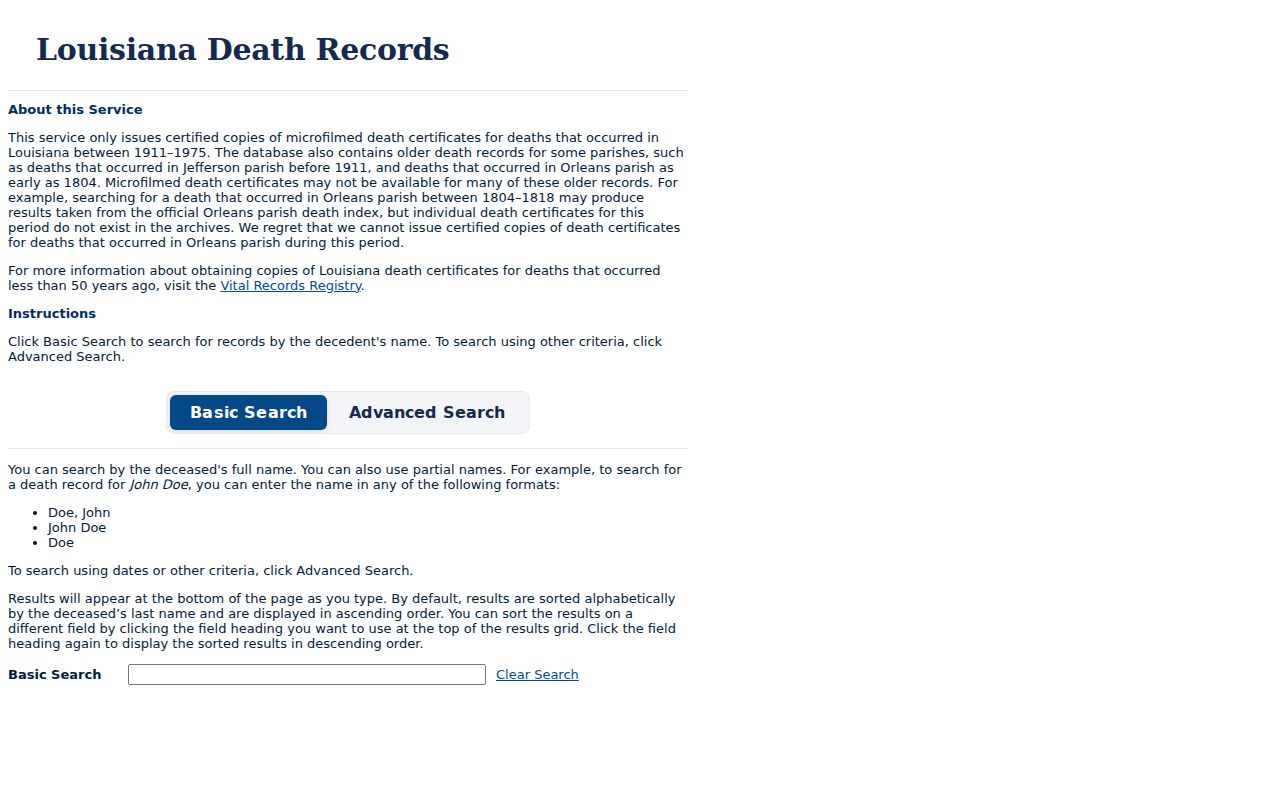
A matching death entry should be checked against age, parish, relatives, newspaper notices, and Clerk probate records before it is assigned to the household.
Bridge Prairieville Address Gaps
No official Prairieville street-renumbering year or complete permit-search field list was found. Do not invent continuity. Compare the current GIS address layer with plats, lot and subdivision fields, USPS verification, old directories, and the deed's legal description. A permit or code case may date work at a parcel, but it identifies a project record, not every person who lived there.
The parish can provide records that are not exposed by a public search form. Under Louisiana R.S. 44:31, an adult may inspect or copy public records subject to lawful exceptions. Ask the Planning and Development or Code Enforcement custodian for a named address, parcel, date range, and record type. The Library and State Archives remain the next stops for old maps, newspapers, and directory gaps.
Use Prairieville History Lawfully
Previous residents research is best used for family history, estate or heir work, and the history of a home. Public records still have firm limits. Utility accounts are not a public resident roll. Protected vital data, adoption records, motor-vehicle addresses, and Louisiana Address Confidentiality Program locations are not ordinary lookup material.
Keep a source date beside each finding. Mark an owner as an owner and an occupant as an occupant. If a living person's location is sensitive, stop rather than publish it. Louisiana stalking and cyberstalking laws prohibit repeated conduct or communications meant to threaten, terrify, or harass.
Lawful use. Trace Prairieville previous residents for personal and historical purposes. Never use an address trail to watch, intimidate, or harm anyone.